DeepSeek-V4 Prompt Engineering: Precise Answers
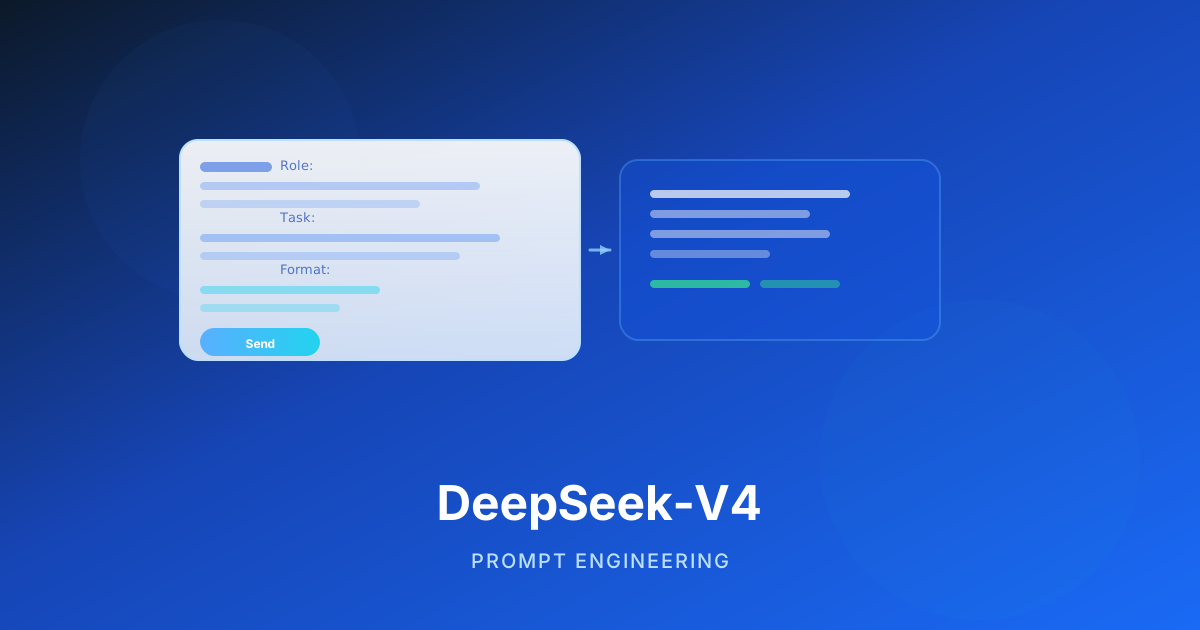
Many first-time DeepSeek-V4 users notice the same question can get wildly different answers depending on how it is phrased. That is not instability — it is DeepSeek-V4 prompt engineering at work. With million-token context and top-tier reasoning, DeepSeek-V4 is highly sensitive to prompt structure, clarity, and constraints. This guide shows how to write high-quality prompts on DeepSeek-V4-Pro and DeepSeek-V4-Flash for more precise, efficient conversations.
Why DeepSeek-V4 Especially Needs Good Prompts
Compared with general-purpose models, DeepSeek-V4 has unique strengths — and unique prompt logic:
| Capability | Prompt impact | Practical tip |
|---|---|---|
| 1M context window | Can ingest huge material — needs structure | Use headings, numbering, highlight key sections |
| Deep reasoning | Supports complex logic chains | Encourage step-by-step thinking; state the reasoning goal |
| Agent capabilities | Can plan multi-step tasks | Define tool boundaries and expected output format |
| Pro / Flash dual editions | Different capability vs latency | Complex tasks → Pro prompts; daily tasks → Flash |
| Strong CN & EN | Chinese prompts work well | Use precise Chinese for professional scenarios |
The core goal of DeepSeek-V4 prompts: help the model quickly understand who it is, what to do, what format to output, and what constraints apply.
The RTFC Framework (Role · Task · Format · Constraints)
For DeepSeek-V4 chats, use the RTFC structure:
R — Role
Tell DeepSeek-V4 which expert to play, e.g.:
You are a Python backend engineer with 10 years of experience in FastAPI and PostgreSQL.
Role setting reduces generic answers and makes DeepSeek-V4 responses more professional.
T — Task
State clearly what to accomplish in one sentence:
Based on the API doc below, find 3 potential security risks and suggest fixes.
Avoid vague lines like “take a look at this” — DeepSeek-V4 cannot guess your real intent.
F — Format
Specify output structure, e.g.:
- Markdown table
- Numbered list
- JSON object
- Three sections: Problem / Cause / Solution
DeepSeek-V4-Pro follows format constraints especially well — ideal for reports and review checklists.
C — Constraints
State limits:
- Word cap (e.g. within 500 words)
- Prohibitions (e.g. do not invent data)
- Citation rules (e.g. answer only from provided docs)
- Language (e.g. Simplified Chinese)
With all four elements, even DeepSeek-V4-Flash delivers stable quality.
Prompt Strategies: Pro vs Flash
Both editions share RTFC, but emphasis differs:
DeepSeek-V4-Pro prompt strategy
For longer, richer prompts:
- Cross-document analysis (legal, academic, technical specs)
- Math proofs, logic, complex decision trees
- Agent coding: cross-file refactors, architecture design
- “Think first, then answer” deep reasoning
Pro tips:
- Allow stepwise output: “List analysis steps first, then the final conclusion”
- Provide full context — use the 1M window in one shot
- Ask for self-check: “Verify no constraints were missed”
DeepSeek-V4-Flash prompt strategy
Flash is faster — great for high-frequency light tasks:
- Email polish, meeting notes, short translation
- Simple code snippets, regex, single-table SQL
- Brainstorming, headlines, social copy
Flash tips:
- Keep prompts short — one task per turn
- Avoid too many nested sub-questions
- Use few-shot examples: “Rewrite in this style: …”
| Task type | Recommended edition | Prompt length |
|---|---|---|
| 100-page compliance review | Pro | Long (full material + constraints) |
| Polish one email | Flash | Short (role + text + tone) |
| Repo-level code review | Pro | Long (tree + key files + checklist) |
| Generate 5 ad headlines | Flash | Short (product + style + count) |
Prompting with Million-Token Context
DeepSeek-V4’s 1M context is a killer feature — long input still needs craft:
1. Front-load a reading guide
Before a huge doc, add:
【Document brief】
- Type: Technical spec v3.2
- Focus: Ch.4 Security, Ch.7 Performance
- Pay special attention to OAuth 2.0 clauses
2. Segment with labels
Use ## Chapter 1 or --- Part A --- so DeepSeek-V4 can navigate.
3. Require citations
Cite source sections in answers, e.g. “see Ch. X § Y”.
4. Multi-turn over one mega-prompt
For very hard jobs, have Pro summarize first, then drill into the summary — often more stable than one giant instruction.
Deep Reasoning Prompts: Chain-of-Thought
For math, logic, and strategy, try:
Pattern 1: Step-by-step
Answer in steps:
- State known facts
- List solution paths
- Derive step by step
- Final answer + self-check
Pattern 2: Comparative analysis
Compare Plan A vs B on cost, risk, and timeline in a table; recommend one with reasons in the last row.
Pattern 3: Counterfactual check
If your conclusion were wrong, what is the most likely reason? Check and correct proactively.
These patterns shine on DeepSeek-V4-Pro, leveraging GPQA/MMLU-class reasoning.
Agent & Coding Prompt Template
DeepSeek-V4 Agent coding needs project context:
Example template
【Project context】
Stack: React + TypeScript + Vite
Issue: Token not persisted after login

【Relevant code】
(paste auth.ts and Login.tsx)

【Tasks】
1. Root cause
2. Minimal fix
3. Unit test ideas

【Constraints】
- No new dependencies
- Keep existing API contracts
For large repos, give directory tree + key paths first, then ask DeepSeek-V4-Pro to dive in.
Five Real-World Prompt Examples
Scenario 1: Weekly report highlights
You are a senior PM. From the notes below, extract 3 upward-reportable wins and 2 next-week plans. Max 40 chars each, numbered list.Great for DeepSeek-V4-Flash.
Scenario 2: Academic abstract polish
You are an academic English editor. Polish the abstract below, keep meaning, improve tone, max 250 words. Output revised text only.Pro or Flash; use Pro for final publication polish.
Scenario 3: Code debug
You are a Python expert. From the log and snippet below, find root cause, explain, and provide fix code. Use sections: Cause / Fix / Code.Cross-file bugs → DeepSeek-V4-Pro.
Scenario 4: Competitive analysis
You are a market analyst. From the three competitor briefs below, compare features, pricing, and audience in a Markdown table; last column: implications for us.Long inputs → Pro.
Scenario 5: Learning plan
You are a learning coach. Goal: master DeepSeek-V4 API in 3 months. Level: basic Python. Build a 12-week plan with topics, exercises, and acceptance criteria per week.Flash for the skeleton; Pro for deep follow-ups.
Common Mistakes & Fixes
| Bad prompt | Problem | Fix |
|---|---|---|
| “Make it better” | Vague goal | Specify audience, style, length |
| 10 questions at once | Shallow or missed answers | Split across turns |
| No background | Model guesses | Add role, scenario, materials |
| No output format | Hard to reuse | Specify table, JSON, list |
| Hard task on Flash, not split | Unstable quality | Switch to Pro or simplify |
| Unstructured long doc | Wrong focus | Add outline and highlights |
How to Level Up Your DeepSeek-V4 Prompts
- Build a personal prompt library — save templates by scenario
- A/B test — try two phrasings, note which wins
- Iterate — point out specific flaws and ask for revision
- Match edition to task — Pro for hard, Flash for daily
- Use site tutorials — see our getting-started and long-document guides
Best practice now: open the web client and rewrite your latest question with RTFC.
FAQ
Chinese or English prompts for DeepSeek-V4?
Both work. DeepSeek-V4 leads on Chinese benchmarks; precise Chinese often wins for local professional tasks. Use English when terms or standards are English-native.
Are longer prompts always better?
No. Flash wants brevity; Pro wants useful length when handling big docs — not repetition. Structure beats padding.
Do I need “magic phrases” like “think like an expert”?
No. Clear RTFC beats empty hype.
Does DeepSeek-V4 remember my prompts?
Within one chat, yes; new chats need context again. For long projects, iterate in one session or paste a brief each time.
Summary
DeepSeek-V4 prompt engineering unlocks the model: RTFC for role, task, format, and constraints; Pro/Flash strategies; structured input for million-token and reasoning workloads. Master these and DeepSeek-V4 goes from “sometimes amazing” to “reliably excellent.”
Try your next question with the new framework: